
TECHNOPAST FRANCE
30110 Branoux


Fabrication de pâtes, machines professionnelles, pâtes par extrusion
12- L’EXTRUSION SOUS-VIDE
- Details
- Hits: 2071
Optimisez la Qualité de vos Pâtes avec l'Extrusion Sous Vide
Pour garantir une production de pâtes alimentaires industrielles de la plus haute qualité, l'optimisation de la phase d'extrusion est cruciale. Notre technologie se concentre sur la mise sous vide de la cuve d’extrusion.
Avantages Clés de nos Extrudeuses Équipées du Système Sous Vide :
Chaque extrudeuse professionnelle est conçue avec un couvercle étanche pour la cuve, reliée directement à une pompe à vide puissante. Ce dispositif réalise une aspiration de l'air efficace, créant un vide optimal dans l'enceinte de mélange et d'extrusion.
- Homogénéité Améliorée : Le processus sous vide assure un mélange plus homogène des ingrédients.
- Aspect Visuel Supérieur : Obtenez des pâtes plus colorées et significativement plus translucides.
- Élimination des Défauts (Pailles) : L'aspiration de l'air permet d'éliminer les bulles d’air emprisonnées (les « pailles »), garantissant une surface de pâte parfaite.
- Résistance Accrue : Les pâtes extrudées sous vide montrent une meilleure résistance mécanique après leur séchage, réduisant la casse et les pertes.
Investissez dans nos machines de fabrication de pâte dotées de l'extrusion sous vide pour une qualité irréprochable, conforme aux standards industriels les plus exigeants.
01- How to make pasta with a press or a sheeter
- Details
- Hits: 8779

Pasta is made from durum wheat semolina, to which a percentage of liquid must be added, between 30 and 33% of the volume of the semolina.
In its 'dry' state, the semolina contains a residual moisture content of 12%, but this percentage can be higher depending on the variety of wheat.
Thus, to obtain dry pasta, the drying process consists of eliminating the volume of water added during the manufacturing process and recovering the percentage of moisture initially contained in the semolina.
02- Which wheat to produce pasta with a press or a sheeter?
- Details
- Hits: 7237
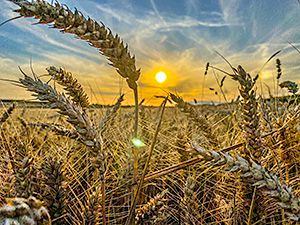
There are many varieties of wheat and their particularities can be appreciated in the pasta, in terms of flavour, colour and texture.
Two main species:
However, all varieties are represented by two main species: "durum wheat" and "soft wheat".
- HARD WHEAT, richer in protein, is the species most commonly used for pasta production and French law requires it to be called "pasta".
- TENDER WHEAT, with a lower protein content, can be used to make pasta (in theory, products made from this raw material cannot be called 'pasta'). The behaviour of soft wheat "pasta" is usually less resistant to cooking, precisely because of its lower protein content.
However, there are specialities, popular in France and Italy, which are produced from common wheat or from a mixture of common and durum wheat.
03- Are all varieties of wheat compatible with pasta production?
- Details
- Hits: 7020
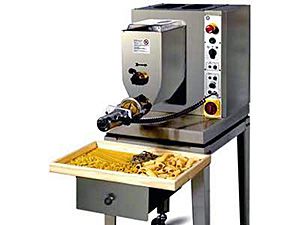
- The equipment for the production of pasta, by extrusion or rolling, is compatible with all varieties of common or durum wheat, provided that the flour or semolina used meets the minimum and maximum required characteristics in terms of grain size, moisture, ash and protein.
- EXTRUSAS or PRESSES are capable of perfectly moulding all types of dough. LAMINOIRS, on the other hand, can only produce flat pasta (all types of tagliatelle, lasagne sheets or rolls to feed a ravioli machine or a cutter).
04- What additives are needed to make extruded or rolled pasta?
- Details
- Hits: 9888

The percentage of liquid added to the semolina/flour may consist of water only or may also contain eggs and other additives, intended to give colour and flavour.
1) The contribution of eggs in the manufacture of pasta:
- They enrich the quality of the pasta (from an organoleptic and nutritional point of view) and add colour. They also "reinforce" the texture of the pasta, especially that produced from soft wheat.
- But they also affect the yield of extrusion production, whose capacity can be reduced by 5% above 3 eggs/kg (about 140g/kg, yolk and white combined) and up to 30%, in case water is fully replaced by eggs.
What does the law say about the presence of eggs in pasta?
- Nowadays, legislation tends to impose eggs in liquid "egg runny" form, as a hygienic measure and to prevent eggshell residues from falling into the dough tank.
- According to the legislation in force, the designation 'egg pasta' must correspond to a minimum percentage of 140 g of eggs per kilo of semolina.
2) Other additives to customise the pasta:
There are many possible additives and you can give free rein to your imagination, as long as you choose these additives in powder or liquid form:
- Spinach, tomato or beetroot juice, for example, which will colour the pasta green or red....
- Cumin powder, paprika and other spices, which will add colour, but above all flavour...
In what form should the additives be incorporated?
- Extruded pasta
For the production of pressed pasta, liquid or powdered forms must be respected, as the dies do not accept larger granulometries, otherwise they will clog;
- Rolled pulp
The production of laminated pulp can slightly deviate from this rule: it allows the use of ingredients (in limited proportions, however) with a particle size slightly larger than that of powder.
Page 1 of 3
